ERP Perfect
ERP Perfect
Description
What is an ERP system
ERP (Enterprise Resource Planning) is software that unifies the core activities of an organization into a single working environment. The modules for finance, warehouse, documents, planning and other processes use a common database and exchange information in real time.
This way departments work with consistent data that is entered once and is available wherever it is needed. This reduces duplication and discrepancies and provides a complete overview of the business.
Key benefits
- Consistent data – the single database reduces discrepancies between departments and duplication of records.
- Enter once – the information is used across the various processes, which saves time and reduces the risk of errors.
- Real-time information – you have up-to-date data on stock, finances and statuses as the work progresses.
- Data-driven decisions – the consolidated information and reports support planning and management.
- Traceability and control – actions and documents are recorded and remain available for review and audit.
- Manageable growth – processes stay connected and organized as the volume of work increases.
ERP Perfect – our solution
Managing production requires alignment between orders, materials, warehouses and the work of the team. When information is scattered across separate programs and spreadsheets, planning and control become more difficult.
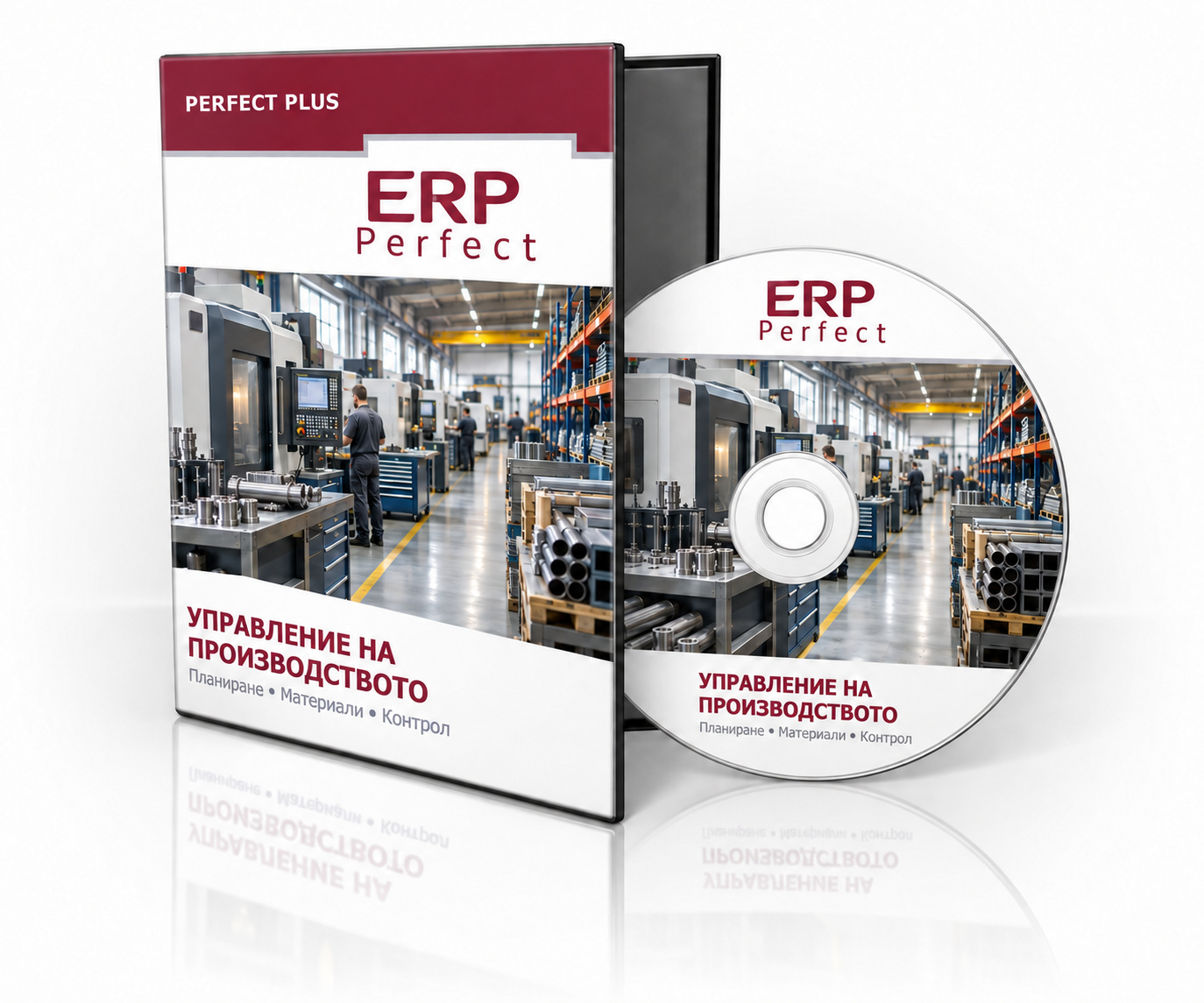
ERP Perfect is an integrated system for manufacturing enterprises that combines the organization of work with detailed reporting of its execution. The system links the requirements of the orders with materials, technological operations and work centers, ensuring traceability of the resources used and the activities performed. This lets you track the progress of production, the hours worked and the costs per product, and control both individual operations and the overall execution.
The system is built on a high-tech stack including .NET and relational databases using SQL.
Key advantages:
- A solution tailored to your enterprise – we configure ERP Perfect according to your specific processes and the way your team works. We add functionalities that match your particular needs.
- Connected planning and execution – you link orders with the required materials, deliveries and production activities. The distribution across work centers and sectors and the reporting of hours worked make coordination and control of the work easier.
- Full traceability down to the operation level – you trace batches through all processing stages and have a history of who performed each operation, when and where. This makes inspections and identifying the causes in case of a problem easier.
- Informed decisions on resources and costs – the current stock levels by warehouses and locations and the cost data help you assess material requirements and production costs.
- Less manual work and re-entry – automating repetitive activities and reusing already entered data saves time and reduces the risk of errors.
- Personal support and a long-term partnership – we keep direct contact with your team, provide training and assistance and develop the system in line with the changes in your enterprise.
Every deployment includes a set of modules and functions tailored to the needs of the specific organization. You choose and pay for the functionality you need and upgrade without interrupting the workflow.
ERP Perfect – connected resources, organized processes and a solution tailored to your business.
Who the system is suitable for
ERP Perfect is suitable for all enterprises that need to automate their processes, work in a single environment and gain better control over their resources. The system unifies information and facilitates the coordination of everyday work. In manufacturing enterprises it connects planning, warehouse management, production and reporting.
Core functionalities
Warehouses and stock – an accurate picture of the movement
ERP Perfect reflects the real structure of the enterprise with multiple warehouses, production locations and grouping options. You have up-to-date information on stock by storage locations and know where the needed materials, products and tools are located.
Receipts, write-offs and transfers are recorded as the work progresses. The received deliveries, the materials used in production and the finished goods all take part in the overall stock picture. This supports planning and supply with information about the quantities the enterprise has available.
Settings and nomenclatures – a system that follows your processes
ERP Perfect uses flexible nomenclatures to organize and describe data. The characteristics of the items and the work structure are configured according to the specifics of the enterprise. This allows the information to reflect your real processes and the system to adapt when the activity changes.
The card of each item combines its characteristics and the data needed for warehouse and production work. Consumption norms and technological cards are assigned to each item. The consumption norm defines what materials and components, and in what quantities, are required to produce it. The technological card describes the operations the item goes through during manufacturing. Different variants can be maintained for a single item, from which you choose during planning.
The detailed description of the items provides a common basis for planning, reporting the materials used and tracking the output. The nomenclatures and the organization of the batches are aligned with the specific requirements of your production.
Contractors, orders and deliveries – connected information in one place
You maintain detailed data on customers and suppliers, linked to the respective orders and deliveries. Customer orders define what must be produced and in what quantities, providing the basis for planning the required resources.
Deliveries let you track the ordered, expected and received quantities. The link with order-based planning makes it easier to secure the missing materials and to coordinate supply, warehouse and production. Invoices and acceptance-handover protocols (AHP) reflect the delivered items and the related business operations and remain available for later reporting and review.
Planning – preparation for the next steps
ERP Perfect lets you plan an entire order or individual items and quantities from it. For a single order you can create several plans and organize the execution in stages according to the needs of the enterprise.
For each item you choose the appropriate variants of the consumption norm and technological card. You can distribute the quantities for production between different consumption norms, choose predefined alternative materials and distribute the required deliveries between different suppliers. This way the plan reflects the specific way in which you will fulfill the order.
The system automatically calculates the required quantities at all levels of the product. The calculations take into account the free stock available and the already planned quantities, so that you know what still needs to be produced or purchased. When the quantities or the selected consumption norms change, the related requirements are recalculated automatically.
After a plan is confirmed, the tasks are routed to the respective modules for deliveries, cutting requests and routing cards. General planning collects the requirements from different orders and lets you consolidate deliveries to a single supplier, as well as production tasks for identical items with the same consumption norm. You can assign the planned quantities in parts, while it remains visible what is yet to be fulfilled.
The link to the original order and its plan is preserved when tasks are merged and split. This way you coordinate supply and production with fewer manual calculations and clear information about the purpose of each planned delivery or production task.
Production – control from the material to the finished product
ERP Perfect covers production from the preparation of the materials to the reporting of the finished goods. The consumption norms define the required materials and quantities, and the technological cards – the operations for manufacturing. The work is distributed across work centers and sectors, which can be grouped according to the organization of the enterprise.
The cutting requests and routing cards link the planned tasks with their execution. Employees report the operations performed, and the accrual of work and the tracking of hours worked by work center provide up-to-date information on the progress of production.
The materials used, the finished goods and the scrap are reflected in the stock levels. The system also supports the assignment of tools to employees with tracking of their handover and return.
Batches and traceability – the history of every product
The system records who performed a specific action, where and when. Batch identification lets you trace the path of the product forward and backward – down to the material used, the corresponding delivery and the supplier. The routing cards complement the history with information about the operations, work centers and performers. This supports quality control, the reduction of complaints and a quick response in case of a problem.
Cost – visibility into the costs of the product
You track the cost according to the incurred expenses for materials, wages, bills and other items. You choose which costs are to be accrued, and the system calculates them over the group of work centers and sectors used for production. You have current information on the cost, which is updated at the end of the month according to the most recently incurred expenses.
Invoicing and finance – a clear picture of receivables and payables
You issue and manage invoices in a common environment connected with the contractors and orders. You track who owes, how much and by when, in order to control due dates and cash flow. The financial reports consolidate the information in real time and support decisions with up-to-date data.
Operational profiles – the right access for every role
Each employee views, fills in and uses the functions and data related to their work. The interface shows the needed menus and screens, which makes everyday tasks easier. Responsibilities are clearly distributed, and access to information is restricted according to the profile.
Reports – information according to your management needs
The connected data allows reports to be produced according to the indicators you want to monitor. When needed, new reports are added over the information from production, warehouse, orders and finance, with the summaries and breakdowns suitable for your decisions.
Deadlines and notifications – timely attention to your events
The system monitors deadlines and tasks and notifies via email, SMS, audible and visual signals. The notifications help the team react on time and reduce omissions in everyday work.
Data exchange and extensibility – connecting with your working environment
ERP Perfect is an open system that exchanges data with other programs and expands with additional functionalities according to the needs of the organization. This allows it to connect with the tools you use and to evolve gradually, without having to replace all solutions at once.
Integrations
ERP Perfect offers the option to integrate with external accounting products for data exchange and to facilitate collaboration between the systems. Such integrations have already been implemented and are used in live deployments of our products.
Deployment and support
We deploy ERP Perfect using a project-based approach tailored to the specific organization. First, an analysis is carried out of the user requirements, the work processes and the operational environment of your organization. The system is personalized and configured in line with the results, with optimal functionality.
This is followed by deployment, data migration and training of the team by operational profiles, tailored to the specific tasks of the employees. We provide user and administrator manuals and technical documentation that support independent work. After going live, we provide support and upgrades in line with the development of the business, with direct contact and personal assistance for questions and difficulties.
As your partner, we cover the entire cycle – consulting, deployment, support and custom software development for specific needs. We combine a high-tech stack – .NET and relational databases using SQL – with many years of experience with organizations from various sectors. We develop the system together with you – we listen to your feedback and add functionalities tailored to your processes and the changing needs of the enterprise.